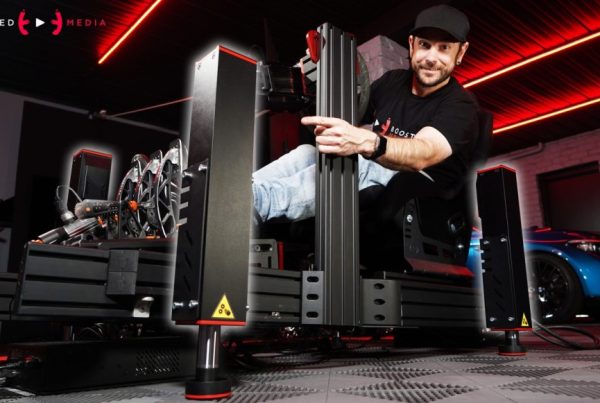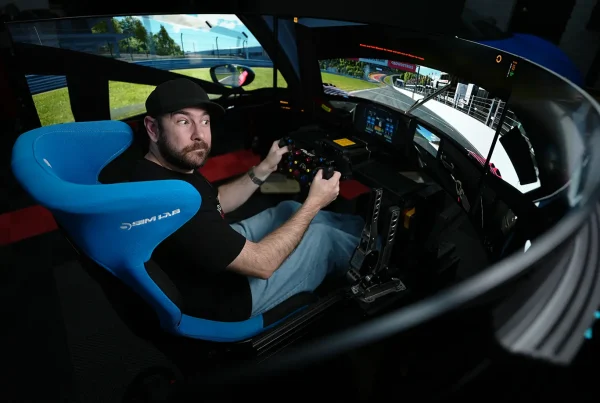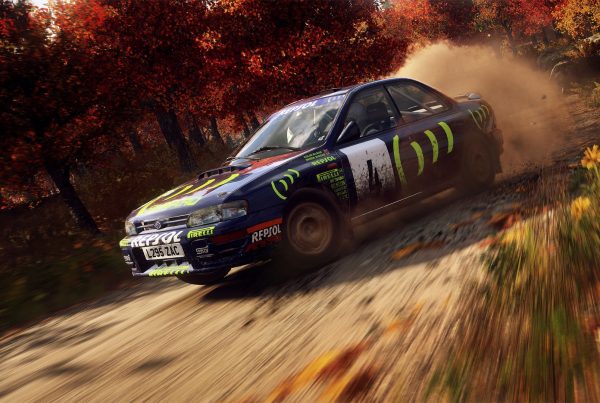


If you’ve ever watched Formula 1, GT racing, or rallycross and thought “Man, I wish I could feel that in my living room” — welcome to SIM racing. Thanks to crazy-good hardware and software, you can now experience the bumps, curbs, and full-throttle drama of racing without leaving home.
But here’s the catch: the world of SIM gear is overwhelming. Endless YouTube reviews, Reddit rabbit holes, conflicting advice… it’s enough to make you throw your hands up before you even start. That’s why we put this guide together. At Sim Racing Works in Bend, Oregon, we help enthusiasts cut through the noise and build rigs that are tailored to their goals, space, and budget.
Let’s walk through what really matters in a SIM rig, then explore some smart setups at $3,000, $5,000, and $10,000 price points. Buckle up, this is gonna be fun.
What to Look For in a SIM Racing Rig
Chassis / Cockpit
This is your foundation. Think of it as your “race car frame.” A good chassis should be sturdy, adjustable, and ready to grow with you. Cheaper rigs flex (not good when you’re yanking the wheel into Eau Rouge). Aluminum profile rigs are the gold standard.
Pro tip: Advanced SIM Racing makes some of the best, no-BS aluminum rigs out there.
Steering Wheel Base
The wheelbase is the engine of your rig. If you want realism, Direct Drive (DD) is the way to go. Instead of pulleys or belts, you get raw torque straight to your hands. That means every bump, slide, and rumble strip feels real.
-
Entry level: smaller DD units like the Simagic Alpha Mini.
-
High end: monsters like the Simucube 2 Pro or Simagic Alpha Ultimate.
Wheel Rims
This is the part you actually hold. F1 wheels look like spaceships with more buttons than your TV remote. GT wheels are simpler, rounder, and great all-arounders. Brands like Simagic, Cube Controls, and Ascher Racing make rims that feel like they came out of a race car.
Pedals
Forget old-school “springy” pedals. Realism starts with load cell or hydraulic pedals that measure force instead of travel. It feels like braking in an actual car and makes your lap times way more consistent. Heusinkveld and Simtag are favorites here.
Motion Systems
Want to feel g-forces and car movement? That’s where motion comes in. Entry-level kits tilt the seat a bit, while high-end platforms like the Sigma Integrale DK2+ move your entire rig around with insane fidelity.
Monitors or VR
Triples give you great side vision (like having proper mirrors). VR puts you right in the cockpit but requires a beefy PC. High refresh rate = smooth racing, so don’t skimp here.
PC & Software
Your rig is only as good as the PC driving it. You’ll want a strong graphics card and CPU to keep the frame rate silky smooth. Pair it with iRacing, Assetto Corsa Competizione, or rFactor 2 and you’re golden.
Recommended Builds by Budget
Alright, let’s get to the fun part. Here’s how we’d spend $3,000, $5,000, and $10,000 to maximize your racing thrills.
$3,000 Budget: Serious Beginner Setup
Perfect if you’re diving in and want Direct Drive without blowing the bank.
-
Chassis: Advanced SIM Racing ASR-4 (~$700)
-
Wheelbase: Simagic Alpha Mini (10Nm DD) (~$600)
-
Wheel Rim: Simagic GT1 (~$300)
-
Pedals: Heusinkveld Sprint (2-pedal) (~$750)
-
Display: Single 32–34” ultrawide (~$400)
-
PC: RTX 4070 + i7 (~$1,200)
-
Software: iRacing or Assetto Corsa Competizione (~$100–$150/year)
? Around $3,050 total. You’ll feel the magic of Direct Drive, pro-grade pedals, and a cockpit that won’t flex when you hit the brakes.
$5,000 Budget: Enthusiast Sweet Spot
This is where SIM racing really comes alive. Better gear, more immersion, and the beginnings of motion.
-
Chassis: Advanced SIM Racing ASR-6 (~$1,200)
-
Wheelbase: Simagic Alpha Ultimate (23Nm DD) (~$1,200)
-
Wheel Rim: Cube Controls GT Pro (~$700)
-
Pedals: Heusinkveld Ultimate+ (3-pedal set) (~$1,200)
-
Motion (Optional): D-Box G5 kit (~$1,200)
-
Display: Triple 27” monitors (144Hz) (~$900)
-
PC: RTX 4080 + i9 (~$2,000)
? About $5,200 total. With this rig, you’ve got pro-level steering, load cell pedals that mimic real race cars, and the thrill of triple screens or even a little motion feedback.
$10,000 Budget: The Dream Build
Go big or go home. This is basically a race car simulator in your house.
-
Chassis: Advanced SIM Racing ASR Pro (~$2,000)
-
Wheelbase: Simucube 2 Pro or Simagic Alpha Ultimate (~$1,300–$1,500)
-
Rims: Cube Controls CSX3 (F1-style,
$1,700) + GT rim ($700) -
Pedals: Simtag or HPP hydraulic (~$2,000)
-
Motion: Sigma Integrale DK2+ (~$5,000)
-
Display/VR: Triple 32” monitors (
$1,200) or Varjo Aero VR ($2,000) -
PC: RTX 4090 + i9 monster rig (~$3,500)
? Around $10,000–$11,000. You’ll have everything pros train with: hydraulic brakes, full-motion immersion, multiple wheels, and visuals so real you’ll forget it’s a game.
Why Work With a Consultant?
Here’s the thing: knowing what gear to buy is just the start. Making sure it all plays nicely together, fits your space, and is tuned so the car feels natural? That’s where most people get lost.
That’s exactly what we do at Sim Racing Works. We help you:
-
Pick the right gear for your goals and budget.
-
Assemble the rig and get the software dialed in.
-
Calibrate everything so it feels just like a race car should.
-
Teach you how to make quick tweaks for different cars or tracks.
We’re based in Bend, Oregon, but work with racers across the country who want a rig that’s more fun and less headache.
Start with Your Goals
The best SIM rig is the one that matches what you want to do. Weekend fun? Online racing leagues? Real-world driver training? Each requires different priorities — but we’ve built them all, and we’ll help you get it right the first time.
Ready to go from dreaming about SIM racing to actually racing? Let’s build your perfect rig together.